

Why choose us?
JINGGUAN GLASS: The main supplier of Budweider, Calsberg and Snow in China. Your Professional Glass Beer Bottles manufacturer!

Professional Team
Our factory has more than 400 employees, including 110 engineering technicians, 5 advanced technicians, and 15 engineers at present.
Advanced Technology
Our factory focuses on technological progress and enterprise management, adopting advanced kiln automatic control system, product automatic inspection system, pipeline electrical and gas heating automatic technology, inner surface of glass bottle rich silicon processing technology, cold and hot end coating technology.


Custom Service
We are good at special design and production according to user requirements, and can carry out deep processing and fine processing such as printing, enameling, plastic spraying, frosting, hot stamping, etc.
Rich Experience
The products not only meet domestic demand, but also meet the needs of overseas markets. Nearly 35% of the products are exported to the United States, France, Kuwait, Australia, Indonesia, the Philippines, Thailand, Singapore, Malaysia and other countries and regions, winning praise from users.

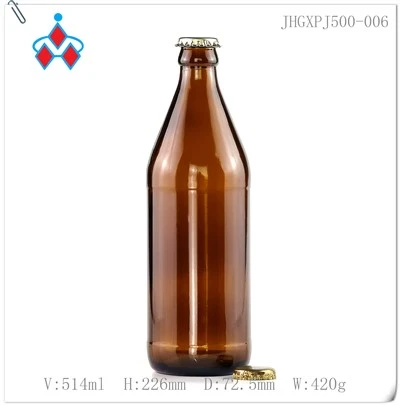

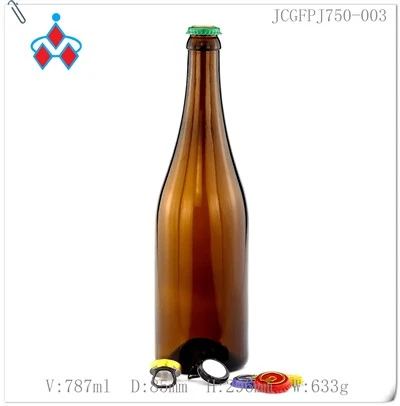


what is Glass Beer Bottles?
As the name suggests, glass beer bottles are glass bottles for beer. To be some extent, it can be said that the most widely used beer container for retail sales is the glass bottle. Although there are many containers for beer, such as cans and kegs. Arguably, however, the most traditional, practical and safest beer container is the glass bottle.
Features of Glass Beer Bottles
Glass beer bottles have many features that make them ideal for storing beer, including:
Protection from light
The amber-tinted glass helps keep ftesh of beer , because UV rays could ruin a beer’s flavor. the darker color helps block out the UV rays.
Temperature control
Glass bottles help maintain consistent temperatures, which helps preserve the flavor intensity of beer.
Chemical inertness
Glass is chemically inert, so it doesn't add any tastes, scents, or textures to the beer it holds.
Pressure resistance
Glass bottles can withstand the pressure from carbonated beverages.
Scratch resistance
Glass bottles are more resistant to scratches and wear and tear than plastic bottles.
Symbolic value
Glass bottles have symbolic cachet from the early days of modern brewing in America.
Types of Glass Beer Bottles
Glass beer bottles come in a variety of shapes, sizes, and colors, each with its own history and purpose. Here are some common types of glass beer bottles:

- Standard (Straight) Bottles: These are the most common beer bottles and come in a variety of sizes, such as 12 oz (355 ml), 22 oz (650 ml), and 750 ml. They have a consistent diameter from the base to the neck.
- Stubby Bottles: Shorter and wider than standard bottles, stubbies are designed to fit in coolers easily and are often used for Session beers.
- Longneck Bottles: These bottles have a longer neck than standard bottles. They are popular in the United States, particularly for domestic beers.
- Codd Neck Bottles: These feature a distinctive glass marble that serves as a stopper. They are less common today but were once popular for certain types of beer.
- Crown Cap Bottles: These are the standard bottles that use a crown cap to seal the bottle. They are the most common type of beer bottle.
- Swing Top Bottles: Also known as Grolsch-style bottles, they have a hinged porcelain stopper with a rubber gasket. They are convenient for homebrewers because they can be resealed.
- Belgian Bottles: These come in various shapes and sizes and are often used for Belgian ales. They can be corked or capped and are sometimes more decorative.
- Weizen Bottles: These are tall, slender bottles with a distinctive bulge near the neck, commonly used for wheat beers.
- Champagne Bottles: Some breweries use champagne-style bottles for special releases or higher ABV beers. They are usually sealed with a cork and wire cage.
- Cyclindrical Bottles: Cylindrical bottles are straight-sided with no significant curves and are used for a variety of beer styles.
- Bomber Bottles: These are 22 oz (650 ml) bottles, often used for special releases or larger format beers.
- Goblet Bottles: Shaped like a traditional beer goblet, these bottles are often used for serving Belgian-style ales.
- Nonic Bottles: These have a slight bulge in the middle and taper towards the top, common in British and Irish beers.
- Green and Brown Bottles: While not a shape, it’s worth noting that beer bottles come in various colors, with green and brown being the most common. Brown bottles are preferred for hoppy beers to protect against UV light which can skunk the beer.

- Punk Bottles: These are designed with a widget (like those used in nitrogenated beers) that creates a creamy head when the beer is poured.
- Conical Bottles: These have a conical shape and are sometimes used for special edition beers.
- Wine Bottle Shapes: Some breweries use wine bottle shapes for their larger format beers, which can add a touch of elegance to the presentation.
Material of Glass Beer Bottles
Modern glass bottles and jars are made using the following:

Soda ash
Silica sand
Limestone
Aluminum oxide
Magnesium oxide
Cullet
Purer silica sand means lower iron content which allows for more control over the resulting glass bottle’s color. The purpose of limestone is to decrease the temperature under which the raw material mixture melts. Aluminum oxide and magnesium oxide are also frequently added to achieve better durability.
Application of Glass Beer Bottles
Glass beer bottles have many uses, including:

Decorations
Glass beer bottles can be used to make wind chimes, wall hangings, room decor, salt and pepper shakers, chandeliers, and bird feeders.
Repurposed
Empty glass beer bottles can be repurposed as vases, coasters, herb planters, or tasting glasses.
Survival gear
Broken glass beer bottles can be used to chip out knives, arrowheads, scrapers, and other tools. They can also be used to boil water for disinfection.
Construction
Empty glass bottles can be used as a foundation in construction. The bottles trap air and create an air pocket in the concrete, which helps insulate the floor from the cold.
Process of Glass Beer Bottles
The process of manufacturing glass beer bottles involves several steps, from the collection of raw materials to the final product ready for filling. Here’s an overview of the process:

Raw Material Collection: The primary ingredient in glass bottles is silica sand, which is mixed with soda ash (sodium carbonate), limestone (calcium carbonate), and sometimes other additives to color or treat the glass.
Batching: The raw materials are precisely measured and mixed in a batch process. The proportions of each ingredient are crucial to achieving the desired properties of the glass.
Melting: The batch is fed into a furnace where it is heated to temperatures ranging from 2,550 to 2,800 degrees Fahrenheit (1,400 to 1,540 degrees Celsius). The high heat causes the materials to melt and form a liquid glass.
Forming: The molten glass is then formed into bottles. Here are the steps involved in the forming process:
Gob Formation: The molten glass is cut into gobs, which are the correct size for the desired bottle.
Blowing and Gob Feeding: The gob is fed into an IS machine (Individual Section Machine) or a blow-and-blow machine, where it is formed into a hollow tube called a parison.
Molding: The parison is then placed into a mold, which shapes it into the final bottle form. The mold has two halves and can be either a one-step or a two-step process.
One-step Process: The parison is blown directly into the final bottle shape in the mold.
Two-step Process: The parison is first formed into a preform in a preliminary mold, then transferred to a final mold where it is blown into the final bottle shape.
Blowing: Compressed air is blown into the parison to expand it against the walls of the mold, taking the shape of the bottle.
Annealing: After the bottle is formed, it goes through an annealing process where it is slowly cooled to relieve internal stresses and prevent breakage.
Inspection and Finishing: The bottles are inspected for defects. Any that don’t meet quality standards are recycled back into the melting process. Acceptable bottles may go through additional processes such as:
Cullet Sorting: If the bottles are to be reused, they are sorted by color and size.
Trimming: Any excess glass, such as the pontil mark where the bottle was attached to the blowing iron, is removed.
Surface Treatment: The bottles may be coated with a thin layer of silicon to make them easier to fill and label.
Capping/Labelling: The bottles are then prepared for capping and labeling, which occurs after they are filled with beer.
Packing: The finished bottles are packed into crates or onto pallets, ready for shipping to breweries.
Components of Glass Beer Bottles

- Glass beer bottles are made from a combination of raw materials, including:
- Silica sand: The primary component of glass, typically making up 60–80% of the composition. The purity of the sand, or the concentration of silica and iron, affects the color of the glass.
- Soda ash: Also known as soda, this is one of the main ingredients in glass.
- Limestone: This ingredient lowers the temperature at which the glass mix melts.
- Aluminum oxide and magnesium oxide: These ingredients improve the chemical durability of the glass.
- Cullet: This is recycled glass that has been prepared for use in the furnace.
Maintenance Tips for Glass Beer Bottles
Here are some tips for maintaining glass beer bottles:
Clean immediately: Clean glass bottles right after use to remove stains and odors.
Use a bottle brush: A bottle-cleaning brush is useful for sterilizing bottles and kegs after brewing.
Use baking soda: Baking soda is a natural abrasive and deodorizer that can help remove stubborn odors and residues.
Avoid harsh chemicals: Avoid using abrasive materials or harsh chemicals when cleaning glass bottles.
Store in a cool, dry place: Store glass bottles in a cool, dry place away from direct sunlight.
Check for cracks: Before each use, check glass bottles for cracks or chips.
Store in a stainless-steel wire basket: Store clean glass bottles in a stainless-steel wire basket to allow for maximum air circulation.
Avoid drying on towels: Avoid drying glass bottles on towels, rubber drain pads, or any other smooth surface, as they can transfer odors and slow drying.
Avoid freezing: Do not keep glass bottles in a freezer, as ice crystals can cause a rapid release of CO2 and create foaming.
Discard bad bottles: Discard bottles that are chipped or cracked, as they can be a potential bottle bomb


Why Choose Jingguan?
Integrated R&D, design, production & custom glass packaging factory
Self-owned large manufacturing plant with complete advanced production equipment
Professional team of 400+ staff, 110 technical personnel & dedicated glass engineers
Full sets of glass melting furnaces, automated & manual forming production lines
Mass stock: nearly 60,000 types of glass bottles & jars
Rigorous quality control for stable long-term cooperation
Trusted by beverage factories, food brands & global distributors all over the world
Our factory


Our Certificate

Our Team


FAQS
Q: How are glass bottles made?
Q: Why beer in a glass bottle?
Q: What are the material properties of glass bottles?
Q: What are the raw materials of a glass bottle?
Q: What minerals are used in glass bottles?
Q: What natural resources are used to make glass bottles?
Q: What are the uses of glass bottles?
Q: Why do we need glass bottles?
Q: Why are drinks in glass bottles better?
Q: Why do people prefer glass bottles over plastic?
Q: What can glass bottles be recycled for?
new bottles and jars.
glass wool insulation for homes, which also helps with energy efficiency.
water filtration media.
Q: Why do people use glass water bottles?
Q: Why are glass bottles so expensive?
Q: What makes old glass bottles valuable?
Q: What is the coating on glass bottles?
Q: What is the finish on a glass bottle?
Q: What lining is used in the caps of glass bottles?
Q: How glass bottles are sealed?
Q: What is the best quality glass material?
Q: What is the white film on old glass bottles?
Q: What kind of glass is used for beer bottles?
Hangzhou Jingguan Glass Bottle Co.,Ltd. is one of the most professional glass beer bottles manufacturers and suppliers in China, specialized in providing high quality customized products. We warmly welcome you to buy or wholesale bulk cheap glass beer bottles from our factory. For price consultation, contact us.