Wholesale Olive Oil & Cooking Oil Bottle Supplier Guide: UV Protection, Non-Drip Finishes & Food-Grade Compliance
Leave a message
How to Evaluate a Wholesale Beer & Beverage Bottle Manufacturer: Pressure Resistance, Annealing, and Export Standards
For commercial breweries, carbonated soft drink (CSD) brands, and international beverage importers, glass packaging failure on high-speed filling lines results in costly downtime and product loss. Selecting a qualified beer bottle manufacturer requires auditing furnace stability, internal pressure tolerances, and export palletization protocols.
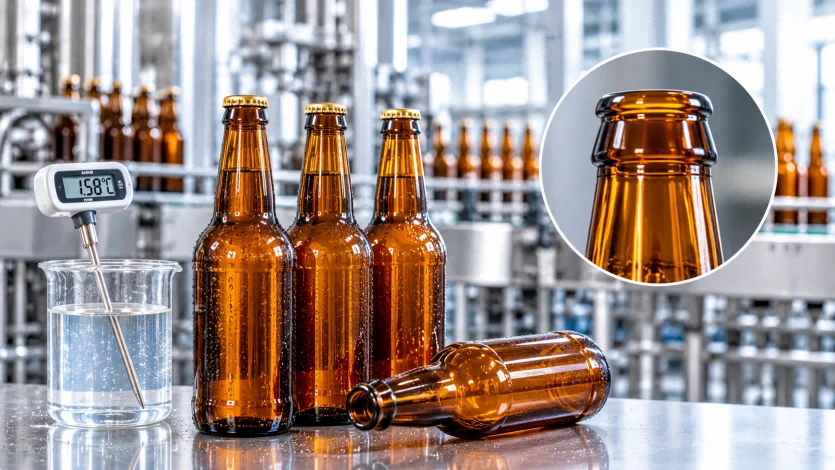
High-speed multi-gob IS forming machines operating under continuous furnace temperature monitoring.
1. Furnace Formulation & UV Protection for Carbonated Beverages
Carbonated beverages-including craft beer, sparkling water, kombucha, and sodas-place strict mechanical and photochemical demands on primary packaging. Unlike static containers, wholesale beer bottles must withstand internal carbonation pressure ranging from 2.5 to 4.5 volumes of CO2 while protecting hop-derived compounds from ultraviolet light.
At a specialized glass bottle factory, raw material batching starts with high-purity silica sand, soda ash, limestone, and carefully metered cullet ratios. To prevent "lightstruck" flavor degradation in beer, amber glass formulations utilize iron oxide and sulfur additives to block over 98% of UV wavelengths between 290 nm and 450 nm. Meanwhile, flint and emerald green formulations are engineered for sparkling juices, tonic waters, and mineral beverages where visual clarity or brand differentiation takes priority.
Consistent furnace melting temperatures (1,550°C–1,580°C) eliminate micro-bubbles, stones, and cord defects-structural flaws that act as stress concentrators during pasteurization and high-speed capping.
2. Precision IS Forming, Surface Coatings, and Annealing Lehrs
Whether sourcing standard 330ml longneck bottles, 500ml Euro bottles, or custom-embossed 750ml beverage containers, dimensional accuracy directly governs filling line efficiency. Even a 0.3 mm deviation in neck finish diameter can cause crown cork leakage or twist-off cap failure.
Narrow Neck Press and Blow (NNPB) Technology
Modern beverage bottle suppliers leverage NNPB forming to distribute glass wall thickness uniformly. By using a precision metal plunger to form the parison before final blow molding, NNPB reduces bottle weight by up to 15% without sacrificing burst strength-lowering ocean freight costs per container for international buyers.
Hot-End & Cold-End Surface Treatments
Immediately after forming, bottles pass through a hot-end coating hood (tin tetrachloride vapor) and subsequently receive a cold-end polyethylene emulsion spray. This dual-coating system reduces surface friction, preventing glass-to-glass abrasion and micro-scratches on automated conveyor tracks.
Controlled Annealing Lehr Curve
Rapid cooling creates permanent internal thermal stress. Our multi-zone annealing lehrs reheat bottles to approximately 560°C and cool them gradually over 45–60 minutes, guaranteeing residual stress levels remain below Grade 1–2 on standard polariscope optical inspections.
3. Quality Control Benchmarks & Technical Specifications
Before releasing any wholesale batch for export, a reliable beer bottle manufacturer conducts 100% automated online camera inspections alongside destructive laboratory sampling per ISO 2859-1 AQL standards.
| Inspection Parameter | Testing Standard / Equipment | Factory Acceptance Benchmark | Operational Impact for Buyers |
|---|---|---|---|
| Internal Hydrostatic Pressure | ISO 7458 Hydraulic Burst Tester | ≥ 1.6 MPa (16 Bar) for carbonated lines | Prevents bottle bursts during tunnel pasteurization |
| Thermal Shock Resistance | ISO 7459 Hot-to-Cold Transfer | ΔT ≥ 42°C without fracture | Withstands hot-fill juice & cold-rinse cycles |
| Vertical Load Strength | ISO 8113 Axial Compression Test | ≥ 5,000 N axial load capacity | Eliminates crushing under high-speed crowner heads |
| Finish & Bore Dimensionality | Optical Vision & Go/No-Go Gauges | ±0.15 mm on 26mm/29mm crown & ROPP | Ensures airtight carbonation retention |
| Heavy Metal Leachability | FDA 21 CFR & EU 1935/2004 | Lead & Cadmium < 0.01 ppm | Full customs clearance in North America & EU |
4. Custom Mold Development, Export Palletization & Case Provenance
Differentiating a beverage brand on crowded retail shelves frequently requires custom shoulder geometry, tactile embossing, or proprietary neck finishes. Working directly with an integrated beverage bottle supplier streamlines tooling development: 3D CAD drawings and acrylic prototypes are finalized within 7 days, sample molds are machined in 15–18 days, and full multi-cavity production molds are commissioned within 30 days.
Export Case Study - European Craft Brewery Supply: In 2025, a regional brewery group in Central Europe partnered with our factory to transition from local distributors to direct container imports of custom-embossed 330ml amber bottles. By optimizing pallet stacking height (2,160 bottles per ISPM-15 fumigated pallet with corrugated tier sheets and UV-stabilized stretch hooding), we achieved 43,200 bottles per 40HQ container with a transit breakage rate below 0.08% across 18 consecutive shipments.
Our dedicated supply chain team maintains buffer inventory for core standard SKUs alongside flexible scheduling for custom runs, protecting buyers against seasonal peak bottlenecks.
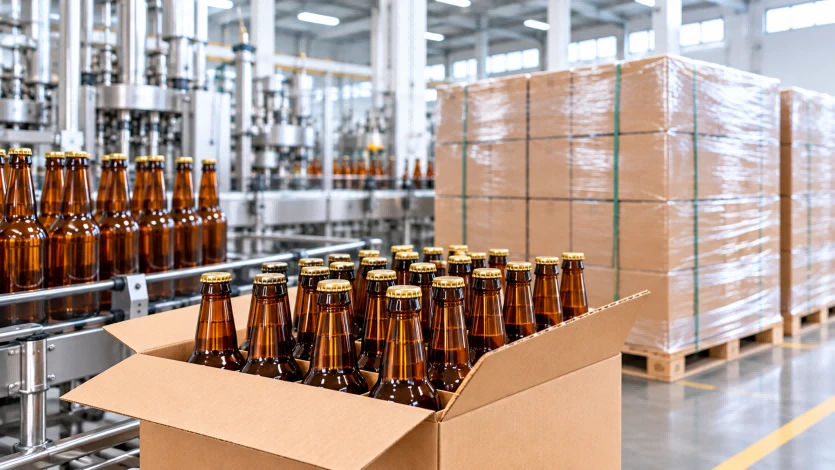
Automated palletizing with slip-sheet dividers and shrink-wrap stabilization for ocean container transit.
Source Direct from a Certified Beer & Beverage Bottle Factory
Looking for standard wholesale beer bottles, custom-embossed soda glass, or matched crown/ROPP closures? Share your target volume, finish specification, and destination port with our engineering team for a detailed FOB/CIF quotation and complimentary sample kit.